from Blame the Devil
EXCERPT ONE: Practically a date. It’s April, 1967, and Dennis, 15, and Donna, 14, head into Greenwich Village, and Donna hasn’t been out of Jersey City much.
The sign for the Gaslight Café was only a few feet above ground level, and the arrow for the entrance pointed to the cellar. They walked down to the entrance and there met an enormous, hairy guy—long curls and a long beard peppered with gray—wearing a dingy T-shirt with a picture of a similarly hairy guy on its front. He looked at the young couple with what seemed to Donna a mix of envy, pity, and amusement, all related to their obvious greenness.
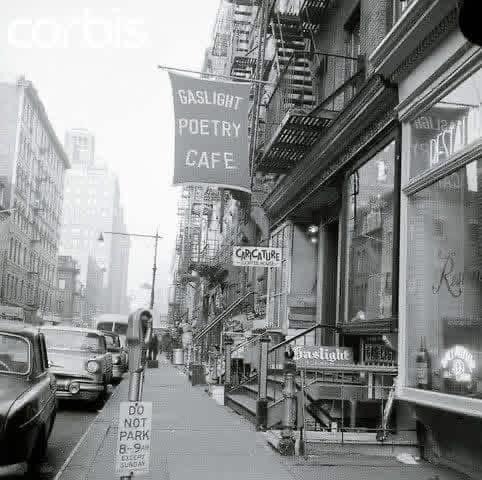
They stood in a puddle into which water continued to drip from the torn awning above.
“How can I help you?”
“Two,” said Dennis. “We’re here for the music, the show. Rambling Jack Elloitt.”
“So is this a ‘cover charge’?” asked Donna.
“You could call it that. A dollar each.”
Dennis opened his wallet, announcing that he would pay.
“Enter, young friends.”
The low-ceilinged cellar that was The Gaslight Café was long and narrow. The walls were crackled with white-painted stone. Twenty or so bare yellow bulbs on wires provided all the light in the place. The bar along the left wall was closed for alcohol (as was the requirement for an afternoon show) but atop the bar were half-gallon bottles of Pepsi, Seven-Up, and Doctor Pepper, a pitcher of lemonade, and pitchers of punch in green, pink, and fluorescent blue: ten cents per paper cup, honor system. Ring-dings, chocolate chip cookies, and lemon pies in plastic-wrap, a quarter apiece, and homemade “Brownies from Rose” for an extra dime. The floor was a tight mishmash of wooden tables, all of them empty except for one. In the back left corner was the stage, on it a microphone and two stools. Folk or hillbilly or country-western music was playing—to Dennis and Donna, it was all the same.
At the one occupied table sat a couple, thirty-ish. The blonde crewcut guy was wearing a red-and-brown flannel shirt, white jeans, and beaded moccasins. The woman was long and angular with black hair onto her shoulders. She wore a gauzy burgundy dress which came down just a few inches onto her shin, legs crossed and one foot flapping, her heel loose from the back of the sandal. The woman smiled warmly. When she noticed Donna and Dennis she gave a twinkly gesture with her fingers as a greeting. Standing in the middle of the room, trying to determine the right table to choose, they smiled back. Dennis did the twinkly finger thing in return. This, Donna found hilarious. The woman nodded to the empty tables right by the stage and shrugged as if to say, “Why not?” Donna took Dennis’s hand and together they marched up to the table in front of the mic.
There was a reason the room was so empty: What Dennis hadn’t gotten was the difference between doors open (12:30) and show begins (2:00), so they had plenty of time to kill. Lesson learned.
“You want to walk around?” asked Dennis. “Look at all the pictures.”
“Sure, why not?”
On the walls were framed black-and-whites of musicians who’d performed there. Donna had heard of only Bob Dylan, Judy Collins, and Peter, Paul, and Mary. Dennis did a bit better. He’d also heard of Woody Guthrie and the Weavers. But then Donna came upon one that was a really big deal. She waved Dennis over. As she gave him a bit of a history lesson, Dennis laid his hand on her shoulder like they were old pals chewing the fat.
The Loving Spoonful was her favorite band. They had real Top 40 hits. And they’d performed right there, in that little room, that room in which they stood. The photo showed the four Spoonful members squeezed together on the stage. Two guys were playing guitars, one was on drums, and John Sebastian was playing what looked like a plugged-in piece of plywood with six strings and two nobs on its face. At the bottom of the photo was barely decipherable scribble: The Lovin’ Spoonful play “Daydream,” June 11, 1966.
It was a wow moment for Donna, a discovery, leaving her shaking her head as her eyes swallowed the entire wall of photos.
Shortly, the room filled with tourists, beatniks, hippies, cowboys—an ensemble of young and old, kids no older than Dennis and Donna, along with gray-hairs, many in sandals and socks and clothes a size too large, several of the women in dangling jewelry made of colorful stones, several of the men with rolled up sleeves and Camels in their T-shirt pockets.
And here they were, just five miles from home.
At two-thirty, a small middle-aged man, shiny bald up front but pony-tailed in back, without saying a word of welcome began reading a list of names from a scrap of paper, most names unknown to the Dennis and Donna. With frequent applause and whoops popping from the crowd, the man read: “Woody Guthrie, Mississippi John Hurt, Cisco Houston, Jack Kerouac, Malvina Reynolds, Lawrence Ferlinghetti, Odetta, John Steinbeck. Pete Seger, Eleanor Roosevelt, Josh White, Bob Dylan, Ken Kesey, Paul Robeson, Ronnie Gilbert, Joan Baez, Johnny Cash, The Carter Family, Dave van Ronk, and soon to be you, are all friends with the man I’m going to introduce: The Legendary Rambling . . . Jack . . . Elliott.” He pointed a finger towards the corner of the unattended bar. There, on a pair of stools, were seated a plain-dressed woman tapping cigarette ash onto the floor, and a cowboy—cowboy hat, pearl-buttoned shirt, worn jeans, pointy boots, a guitar on his back. He made his way between tables to a standing welcome of applause, hoots, whistles, and friends shouting hellos: “Hey, Jack!”
Jack took a theatrical bow, tipping his cowboy hat when he reached the stage.
“Hey, kids,” he said to Donna and Dennis before he stepped up. “Tell me how I’m doing.”
“Got it.” Dennis smiled.
“What are your names?” he asked, one foot onto the stage.
“Donna.”
“Dennis.”
“I’m Jack. I hope you have fun today,” he said, and used Dennis’ shoulder to keep balanced as he climbed up.
Ramblin’ Jack got settled on his stool, said a few Thank Yous and a few Hellos. He then launched into a meandering story as he strummed and tuned his guitar: He’d taken a Greyhound to New York from Nashville where he’d appeared with Johnny Cash on a TV show. One customer shouted, “Ramble on, Jack.” And so he did. Jack rambled on about Cash and his marriage troubles, Jack’s Sun Records almost-deal, his history at the Grand Ole Opry, the two-hour wait at the Nashville bus station, and the crazy-funny nightmare he’d had on the ride up: “Damn, I didn’t know what was scarier, the dog with the blood-drooling mouth and Lugosi eyes or the old lady’s teeth chasing me around the dance floor.” Pause for some strumming. “Damn near scared me out of my drawers.”
EXCERPT TWO: Father Wayne, at the request of her dad, keeps Donna company (only twelve at the time), on the evening her mother is dying
Donna returned to the living room carrying two glasses.
“Mine is ginger ale and ice and a tiny bit of whiskey.” She handed Father his drink and took a sip of hers. “A High Ball, that’s my mom’s drink. I made it very, very weak. Is that okay that I made one for me?”
“Yeah, I guess so,” Father smiled, his sympathy merged with true love for the sweet child. “Then maybe you should go up to sleep.”
“I think I’m going to sleep down here. I do that sometimes. I put a show on and fall asleep. Twilight Zone episodes are on at ten. Channel eleven. That’s okay, isn’t it?”
“If it makes you comfortable.”
“Will you stay until my father gets home?” she asked as she rose and switched to channel eleven. “I’m still worried but I don’t think I’ll be as jittery this way.”
Donna liked Father very much. In fact she had no problem saying she loved him—a lot of the girls said it. She knew that he was a kind person, and she knew that there was a field of sadness surrounding him, that in his soul there was a big hollow. She lay on the couch on her side, her breath easy, as Rod Serling introduced the “Night Call” episode:
You unlock this door with the key of imagination.
Beyond it is another dimension:
A dimension of sound, a dimension of sight, a dimension of mind.
You’re moving into a land of both shadow and substance,
A land of both of things and ideas.
You’ve just crossed over into… the Twilight Zone.
Tonight’s episode is a small bit of the tragic and macabre:
Late one evening, an elderly woman receives of phone call
From her long ago ex in this episode: “Night Call.”
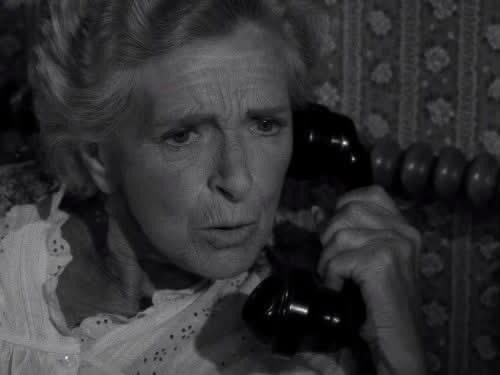
As Wayne, fatigued and sipping, observed Serling conclude his monologue, Donna eyed her priest friend with admiration for his compassion and trustworthiness. There were such people in the world, such good men, solid as rocks.
Then, her eyes fell closed, her breathing periodically interrupted with sniffles. Father looked at her, admiring and loving her. She was the embodiment of all that was desirable in human existence: innocence, sweetness, hope, loveliness, trepidation, a future uncharted. Further back in his consciousness he wept for his opposite state.
The episode ended and, in a grave voice, the host returned with the moral of the tale: “According to the bible, god created heaven and earth. It’s man’s prerogative, and woman’s, to create their own particular hell.”
With that, the show ended. Even before the 11:00 News came on, both the priest—formal, still oozing propriety, feet planted, hands on his knees—and the twelve-year-old girl—on her side on the couch, knees bent, her folded hands squeezed comfortingly between them—were sound asleep.
EXCERPT THREE: Uncle Hubie knows that sometimes a hanging is called for.
It was Halloween Eve, and Hubie had already hung four men in Mexico, one Apache, one Mexican, and two Americans, for smuggling weapons to the Villa rebels. The boys at Lenape had had too much to drink and a crew of camp bullies, the dozen West-Virginian Wheeling Boys, took things too far, fabricating a feud between themselves and a less belligerent group of corpsmen over a marked deck and a five-dollar bill. The Wheeling Boys humiliated and bullied this group into a brawl in the thin woods that sprouted at the encampment’s north edge. During the brutalization which scattered deeper into the woods where the action was out of view, two burly but sheepish Italian men were beaten to death. The only ones to witness these beatings were other Wheelings who, of course, remained tight-lipped throughout the investigation, and the shamed, emasculated corpsmen, were too scared to make a peep. Two men from Rhode Island had been killed and the case left unresolved, with not a single individual accused or charged. The entire camp suffered equally: no fresh meat, no booze, and no off-grounds passes for six weeks. The men were infuriated by what had gone down—the Wheeling Boys had beaten two men to death, and now they had wholesale run of the camp; their intimidation and belligerence continued, even ticked up a notch; and the three sons of bitches had gotten off scot-free. While, yes, all the men were infuriated, Hubie’s rage was of another level—a level which only action would satisfy.
He called together a dozen comrades and told them what he was thinking. Charged with moonshine-laced birch beer, they agreed to Hubert’s scheme so immediately and with such enthusiasm, such pride, such roaring exultation, that by the time they left their hourlong meeting, the idea was a plan. Hubie—the Merry Hangman—would run the show. If the others had any helpful supplies or expertise, they’d provide them. But most essential, everyone at the meeting must be in attendance to share responsibility. The morning was set and the boys showed up with everything that might be needed: bats, brass knuckles, chain, rope. The two boys from the Delaware Bay Region carried their pellet guns.
Given his experience in Mexico, building a gallows would normally take Hubie just a few hours. This construction took the entirety of the preceding day. For one thing, this was a triple hanging, but additionally, in a scheme of which he was quite proud, Hubert—always a lover of the dramatic—decided to build the gallows in a shallow of Coyote Creek. Photox 10
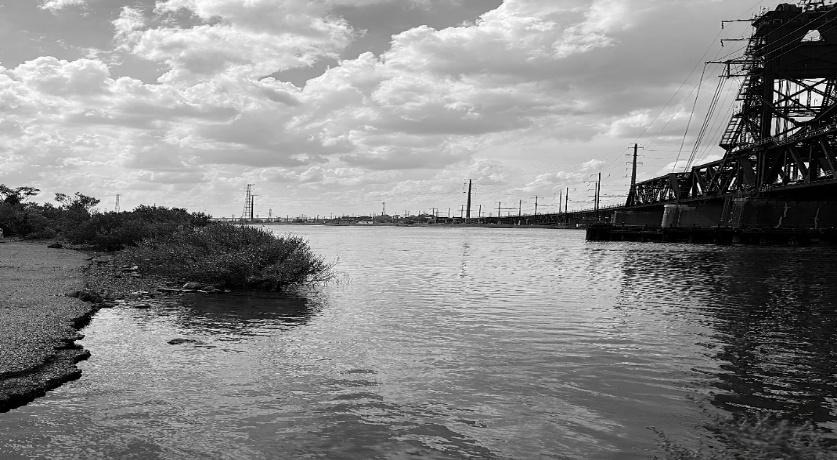
In the early morning hours four days before Thanksgiving the three perpetrators were beaten until they were incapable of resistance. Then they were offered free whiskey which they guzzled. They were blindfolded. Their ankles were tied together, their hands were tied behind their backs. With those about to administer justice alongside them the Wheeling Boys hopped up the four steps. Atop the platform, Uncle Hubie centered the three men, slipped the nooses around their necks, tightened them, then stepped away.
“Pull it,” Hubie yelled. Out went the floor, and the three men fell through the trap, dangling up to their shins in shallow water.
Once the men stopped their splashing and settled into pendulum swaying, all it took was a snip-snip and a couple of nudges forward, and one by one the bodies floated downstream, gaining speed along the route from Coyote Creek into the Hackensack, down the Hackensack to Newark Bay then out to sea. Gone, they were, and no one really cared. Justice had been served. Before the steam whistle signaled the noon hour, a pig was placed on the spit, two brothers from North Carolina took out their guitars and a singalong ensued:
This little light of mine, I’m gonna let it shine,
This little light of mine, I’m gonna let it shine,
Let it shine, let it shine, let it shine.
Downed trees served as benches, beer flowed freely, and the group felt the fierce camaraderie of a job well done.

